Showing posts with label guest. Show all posts

Thursday, 13 June 2019

Guest Post: Illustrating Sophie Johnson - Ella Okstad


I'd love to give a warm welcome to Ella Okstad today, who has written a great post about coming up with the initial illustrations for a new picture book series and to share some of her early sketches! I'm very much a fan of Ella's style and it's one which I admire and would love to be able to emulate!

Illustrating Sophie Johnson - Ella Okstad

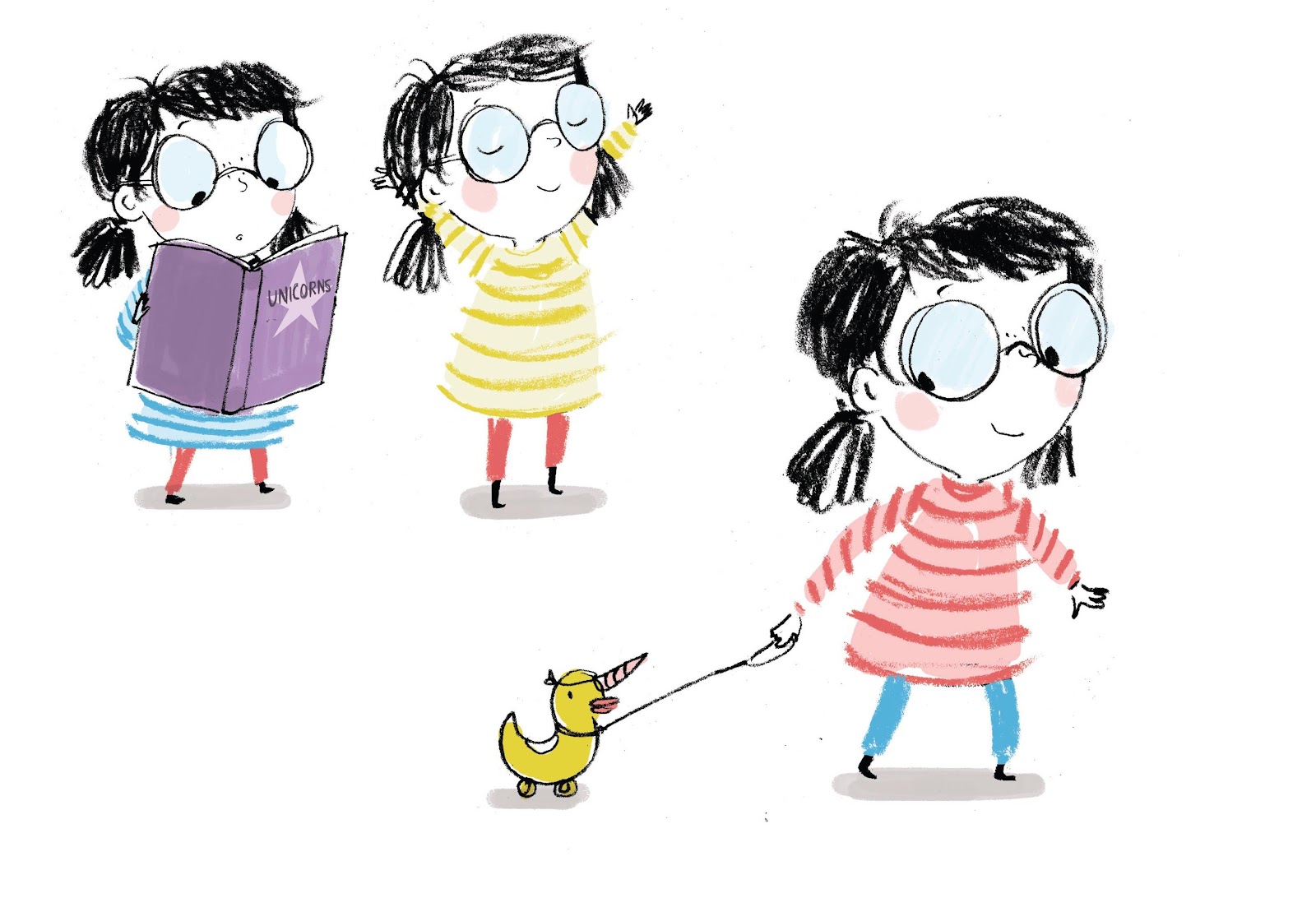
When I first read the Unicorn Expert it was instantly clear to me how Sophie would look. As she is a self-confessed expert on unicorns and a detective genius it was very important to capture this in how she moves and behaves. For the Unicorn Expert, the publisher sent me a link to a John Lewis Insurance commercial video to describe her personality which I felt was really on point.

C:\Users\ohorr0611\AppData\Local\Temp\wz0507\Sophie\Sophie_sketch.jpg
I wanted her to have a simple stripy dress and a couple of thin legs. This way it would be quite easy to mover her around. Her face is dominated by a large pair of round glasses which gives her an important look; she is, after all, an expert and it also makes room for lots of different expressions.


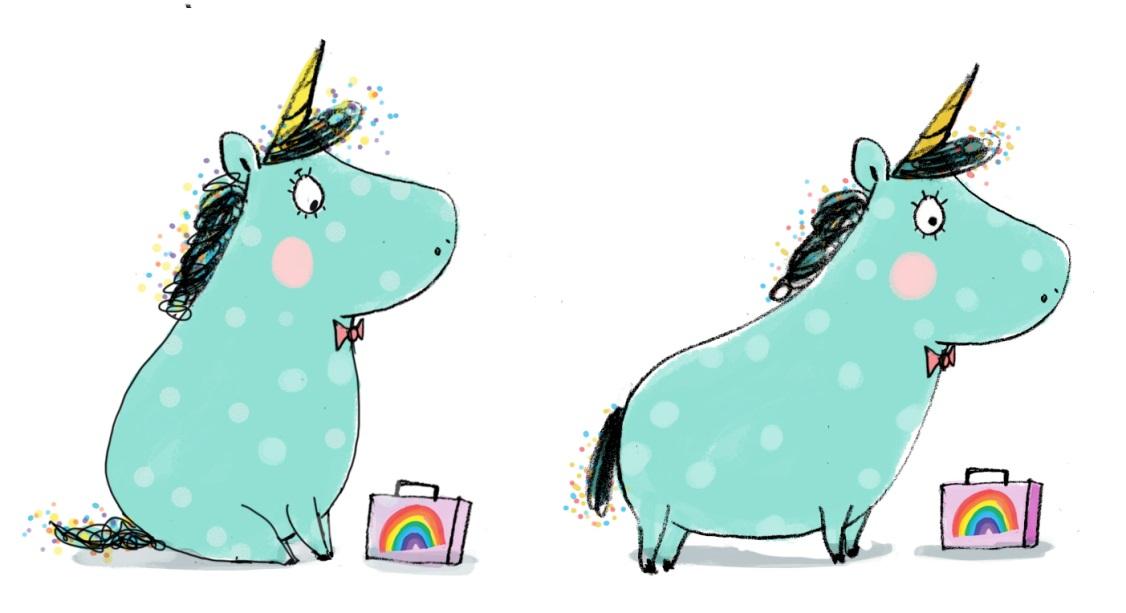
Whereas Sophie's look came quite instantly, the real Unicorn was a little more tricky. At first, I imagined it to be quite flamboyant with a more horse-like body and a long wavy tail and mane. Then after re-reading the text and sending a couple of emails back & forth, we decided to go with the chubby quite insecure type of unicorn. It is, after all, seeking unicorn advice from the world's best unicorn expert!


C:\Users\ohorr0611\AppData\Local\Temp\wz6954\Sophie\first_unicorn_rough2.jpg
C:\Users\ohorr0611\AppData\Local\Temp\wzadd2\Sophie\unicorn_final.jpg

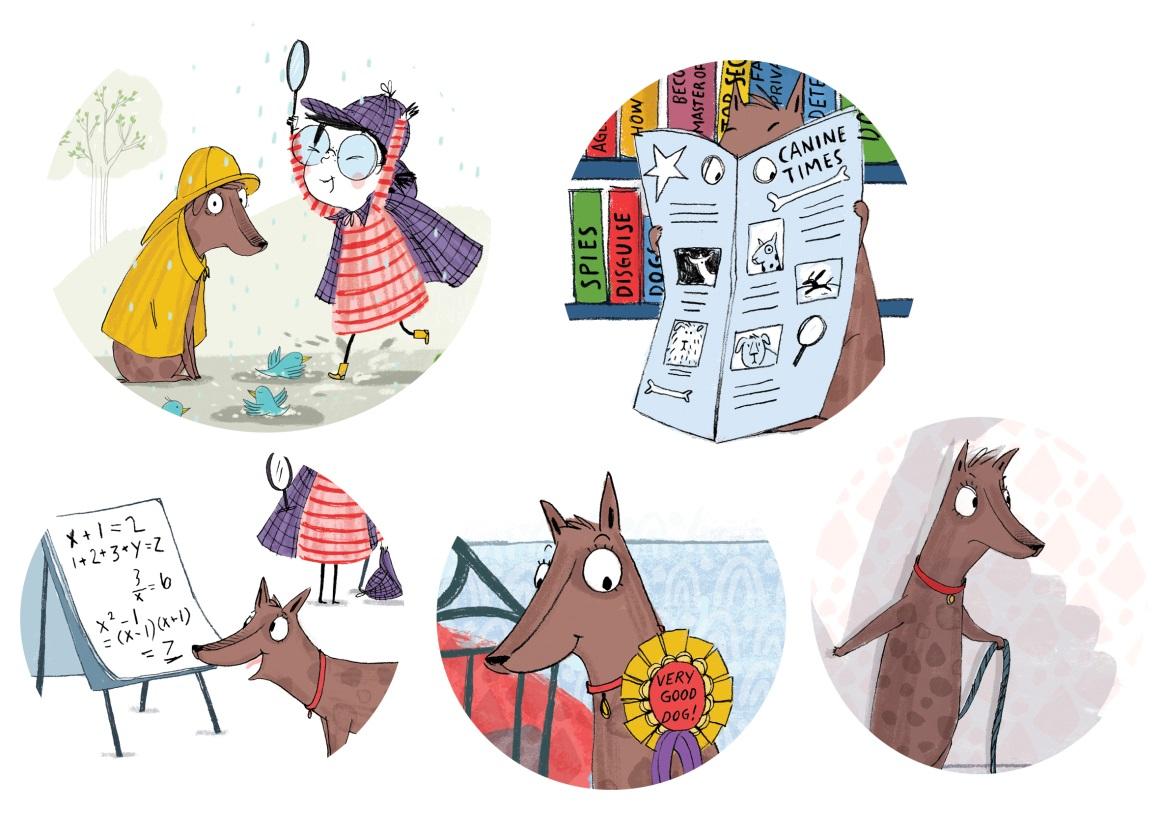
In Detective Genius, Bella the dog is always there with an attentive look keeping an eye on Sophie. She is the true detective!

C:\Users\ohorr0611\AppData\Local\Temp\wz1452\Sophie\bella.jpg

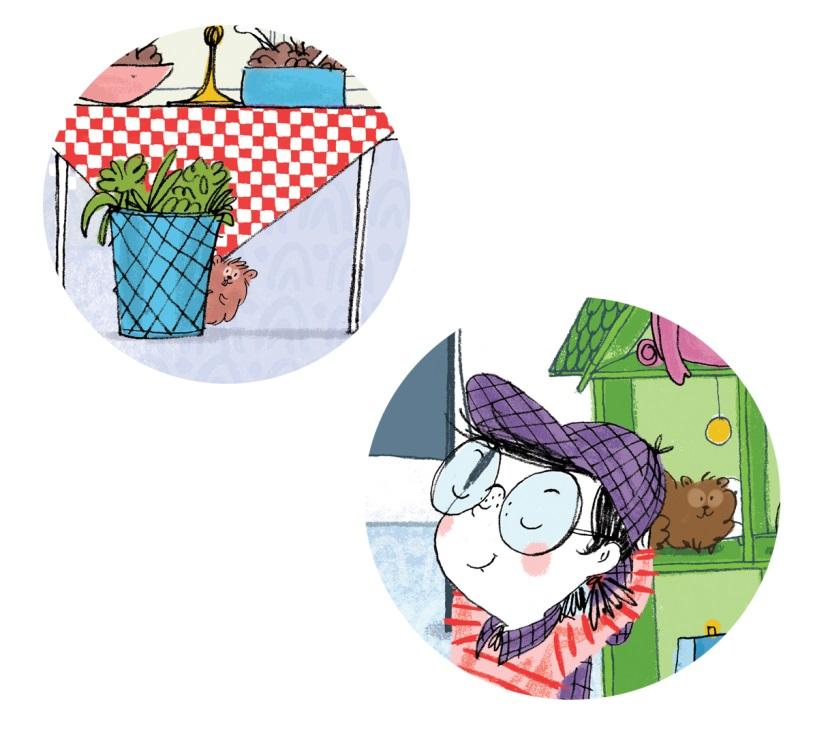
The guinea pig from Unicorn Expert can be spotted a couple of times in Detective Genius. Have another look and see if you can spot it hiding in the pages!

C:\Users\ohorr0611\AppData\Local\Temp\wzb7b2\Sophie\guineapig.jpg


Review Links

Sophie Johnson: Unicorn Expert

Sophie Johnson: Detective Genius


Monday, 7 January 2019

Guest Post: Top Books & TV For Young People With Neurodiverse Heroes


Before the wonderful Emily at Scholastic contacted me about taking part in the blog tour for Lightning Chase Me Home, I had already added the book to my wishlist. Having nearly all my nephews and a niece with dyslexia and various ADD diagnoses it had attracted my attention as there aren't that many books out there featuring children like them, or indeed television programmes. It's becoming more common now to see neurodiverse characters but in case you need some amazing recommendations I hope you enjoy this post by the author of Lightning Chase Me Home, the lovely Amber Lee Dodd!

Top Books & Television For Young People With Neurodiverse Heroes

Neurodiversity is quite simply anyone whose brain functions differently to the norm. It’s a term unlike disability, or learning difficulties, that can be used to celebrate people’s differences. The idea of celebrating and spotlighting characters, whose unique way of seeing the world, thankfully has been growing in literature and media. Lightning Chase Me Home can join other great books to have main characters with dyslexia such as Maggot Moon by Sally Gardener, Percy Jackson by Rick Riordan and Pages and Co by Anna James.
As for books portraying autism, we have amateur detectives and puzzle hunters like Christopher Boone from The Curious Incident of The Dog in the Night Time by Mark Haddon,  Kieran Woods from Smart by Kim Slater and Oskar Schell from Extremely Loud and Incredibly Close by Jonathan Safran Foer. We also have usual thinkers in the protagonists Rose from How to Look for a Lost Dog by Anne M. Martin and Willow Chance the misunderstood genius in Counting by Sevens by Holly Goldberg Sloan.
In television we have detectives like Sherlock, who although are not explicitly identified as being in the autistic spectrum, have many identifiably autistic-like traits, like hyperfocus and unique puzzle solving abilities. Its Sherlock’s unique mind that makes this show such a compelling watch. There’s also another teen series of Atypical, which follows the life of autistic teen Sam Gardener due out on Netflix. And not only do we have the first female Dr. Who, but we have her lovable dyspraxic side kick Ryan. The first time we meet Ryan he’s struggling to ride a bike,  he’s clumsy, uncoordinated and hugely flustered at himself. It’s something entirely relatable to so many children and adults with dyspraxia. And for me, the kid who was banned from skipping, it’s a triumph.

These are just some of the highlights of recent children and teens books and programming. And I hope it’s just the start of us seeing a different kind of hero.

About The Author

I was born and grew up in Portsmouth. The only Island city in the UK!

I hated reading when I was younger as I really struggled with it. I even ended up being the very last of my class to come off the reading books. But now I couldn't imagine going to bed without a book.
My favorite book changes all the time! There are just so many new and wonderful books being written. But I will forever have a soft spot for The Illustrated Mum by Jacqueline Wilson. It's the one book I got signed when I was younger and I still have it by my bedside.  

My favorite explorer changes all the time too. I just keep learning about more and more amazing ones. At the moment I'm reading about the adventures of the journalist Nellie Bly, who traveled the world in 72 days.

If I had a daemon or a patronus, it would probably be a platypus which is one of nature's most unlikely animals. It's part duck, beaver and otter. But whilst they look very silly on land, they are fierce underwater hunters.

Find Amber on Twitter, and Instagram!

Please do check out the rest of the blog tour for interviews, guest posts, and reviews!


Thursday, 15 November 2018

Guest Post: How Important Is Research In The Modern Crime Novel? - MJ Lee


I'm thrilled to welcome MJ Lee to the blog today, talking about researching a modern crime novel!

How Important Is Research In The Modern Crime Novel?


In the old days, life was quite different for crime writers. Agatha Christie didn’t have to research modern forensic science, nor did she bother herself with the minutiae of police hierarchy or the competence of a Coroner.’


Instead, she researched the effects of poisons, a knowledge boosted by her time spent as a nurse during World War One. Hercules Poirot relied on his ‘little grey cells’ to solve a dastardly murder. While Inspector Japp was content to bungle on until his incompetence could be demonstrated.

While the ‘cosy’ mystery still exists, it has been replaced by a much stronger emphasis on authenticity in crime fiction. People have watched CSI and so they are well aware of the methods of DNA analysis or of blood detection in a crime scene. They had watched countless episodes of COPS so they aware of the communication procedures of police on the beat. And ‘fly on the wall’ documentaries of actual cases, the most recent being the brilliant ‘Making of a Murderer’ ensure that the reader has a pretty good idea of what should happen in a crime story.

So it’s important for the writer to get it right if he or she wants to maintain credibility. So before I even touched fingers to keyboard for Where the Truth Lies, I made sure to get the details were as accurate as I could. In short, I had to become a detective of the process of modern detection

For this novel,  there were four main areas where I needed to make sure the facts were correct; the Coronial System, the police force, modern forensic science, and the treatment of cancer.

First, I read general books on the legal system, with particular emphasis on the Coroner’s courts. They were founded just after the Norman Conquest in 1066, created then as servants of the crown (hence coroners) to separate the investigation of death from the legal process of judgment. Not a lot has changed since then. I spent quite a lot of time attending inquests to get a feel for the language and the procedure.

I then researched the modern police forces of the UK, who I’m sure you’re aware have come under immense pressure in the last few years, talking with ex-members of the GMP, Scene of Crime Officers and police support workers. Some of their stories were fascinating and I’m sure will form the background for future novels.

To understand modern forensic science methods, I attended courses on forensics, the science behind DNA, facial reconstruction, the procedures of a Scene of Crime Officer and read extensively in the subject.

Finally, I researched the field of cancer. Luckily, Manchester has one of the world’s leading research and treatment hospitals, Christie's, and I was able to find out from patient’s themselves what it felt like to be diagnosed and treated for Myeloma.

Hopefully, this research is reflected in the book, allowing readers to understand the obstacles police have to endure to obtain a conviction based on evidence. Obviously, it is still a fiction book not a slice of real life, but in doing all this research I hope it helped create a world that feels authentic.

But in the end, all the research in world won’t make a bad book good. Because research only fills in the details making the story believable and authentic, not worth reading.

I hope you enjoy reading Where the Truth Lies. I’m presently editing the second story in the Ridpath series which should be coming out in 2019.

And, guess what, I’m now researching the decomposition rate of bodies. I hope the police never have cause to look at my search history….

About The Author


M J Lee has spent most of his adult life writing in one form or another. As a university researcher in history, he wrote pages of notes on reams of obscure topics. As a social worker with Vietnamese refugees, he wrote memoranda. And, as the creative director of an advertising agency, he has written print and press ads, TV commercials, short films and innumerable backs of cornflake packets and hotel websites.
He has spent 25 years of his life working outside the north of England, in London, Hong Kong, Taipei, Singapore, Bangkok, and Shanghai, winning advertising awards from Cannes, One Show, D&AD, New York and the United Nations.
While working in Shanghai, he loved walking through the old quarters of that amazing city, developing the idea behind a series of crime novels featuring Inspector Pyotr Danilov, set in the 1920s.
When he’s not writing, he splits his time between the UK and Asia, taking pleasure in playing with his daughter, practising downhill ironing, single-handedly solving the problem of the French wine lake, and wishing he were George Clooney.

Twitter - @WriterMJLee


Wednesday, 29 November 2017

Guest Post: Do's And Don't's Of Crime Writing - G J Minett


Today on the Outsider it's a pleasure to welcome G. J. Minett, whose latest book is Anything For Her, an amazing follow-up to The Hidden Legacy and Lie In Wait. My review of Anything For Her can be found here, and huge thanks to G. J. Minett, Emily Burns & Bonnier Zaffre for including me on the tour! Enjoy reading reading G. J.'s post on what you should and shouldn't do in crime writing.

Dos and Don’ts of crime writing

DO keep a healthy balance between plot and character. It’s so easy to get carried away with the storyline but readers need to see the development of a central character they can believe in and care about. They don’t want cardboard cut-outs or cartoon sketches.
DON’T make the central character a paragon of virtue. Readers like to identify with someone who is flawed, maybe unreliable or even dangerous, as long as the redeeming features outweigh the negatives.
DO make sure you come up with an opening that grabs the reader’s attention. Most people have a ‘to be read list’ that is spiralling out of control and not everyone sees every book through to the end.
DON’T confuse pace with breakneck speed. Pace is a variable, not a constant. If every scene ends with a cliffhanger and the hero wriggles out of seemingly impossible situations every 30 pages or so, the overkill will alienate the reader. Remember: pace can be measured and considered, allowing everyone a chance to take a deep breath and prepare for the next onslaught.
DO treat your readers with a bit of respect. If they are prepared to devote several days to reading what you’ve produced, there’s a duty of care and you need to avoid huge coincidences or Deus ex Machina interventions that could have been avoided with a little more imagination and effort.
DON’T agonise for too long over the quality of what you’ve written on any given day. Get it down on paper – you can always improve on what’s there at a later date. It’s when there’s nothing there to work on that you have a problem.
DO showcase your skills. Everything you picked up on writing courses and in workshops is just as relevant in a crime novel as in any other genre and readers are perfectly capable of appreciating quality writing wherever they find it.
DON’T go out of your way to imitate. Find your own style and work at it from novel to novel. If you are too anxious to copy others you’ll inevitably lose out in any comparison. Make your own writing the yardstick.
DO think hard about your locations. Some readers derive considerable pleasure from a setting they know well and the demands of plotlines and word counts can sometimes prevent writers from giving the story the detailed backdrop it might need.
DON’T info dump. It’s so tempting, when you’ve researched something in great depth, to want to demonstrate what you’ve picked up but the aim of the research is to provide a backdrop, not dominate the page.
DO provide a twist or two to keep the readers on their toes. A real surprise at the end is particularly effective as it’s what the readers will take away with them. Be careful not to overdo it though – by definition, these twists are out of the ordinary and the difference between the unexpected and the utterly implausible can be wafer thin.
DON’T kid yourself that there’s a substitute for sitting down in front of the laptop and writing. There’s not. There are distractions aplenty and you can try to justify them in the name of research or downtime or networking but what gets the novel written is sheer hard graft and a bit of inspiration. Sit down, shut the door and WRITE.

Having said all that, I do most of the don’ts – and fail to do most of the dos – at least 50% of the time. All part of the fun of being a writer.

Anything For Her - G. J. Minett
Publisher - Bonnier Zaffre
Release Date - November 30th, 2017

About The Author

Graham was born in Cheltenham, Gloucestershire and lived there for 18 years before studying for a degree in Modern and Medieval Languages at Churchill College, Cambridge.

He taught for several years, first in Cheltenham and then in West Sussex before opting to go part-time and start an MA in Creative Writing at the University of Chichester. Completing the course in 2008, he gained a distinction for the dissertation under the guidance of novelist, Alison MacLeod and almost immediately won the Segora Short Story Competition with ‘On the Way Out’.

Other awards soon followed, most notably his success in the 2010 Chapter One novel competition with what would eventually become the opening pages of his debut novel. He was signed up by Peter Buckman of the Ampersand Agency, who managed to secure a two-book deal with twenty7, the digital-first adult fiction imprint of Bonnier Publishing.

WebsiteTwitter | Facebook


Monday, 17 July 2017

Spooky Settings That Inspired Robyn Silver - Paula Harrison


Paula Harrison is back with the next book in the action packed 'Robyn Silver' adventure series. I absolutely loved The Midnight Chimes and The Darkest Dream is even better. The boldest, brightest new heroine has returned: and Robyn Silver’s life hasn’t got any quieter since defeating the evil vampire Pearl in The Midnight Chimes. She’s now a fully fledged Chime Child and monster-hunter-in-training alongside best friends Aiden and Nora. The three suddenly start seeing nightmares -  in the form of black beetles - appear around town. Who wants the people of Grimdean to be losing sleep - and why?
To celebrate the release of 'The Darkest Dream' here is a fantastic guest post from Paula Harrison about places that helped to inspire her. I don't need to say anything about the fact that this is actually a list of some of my favourite fictional places...

Five spooky settings in stories that helped inspire Robyn Silver: The Darkest Dream
One of my favourite parts of writing Robyn Silver was inventing the spooky settings. Some are classically spooky such as Grimdean House, a mansion with monsters imprisoned in the basement, secret tunnels inside the walls and a barn full of bats in the garden. Sometimes I enjoyed the thrill of turning a familiar place into a spooky setting, such as the time Robyn and Nora meet a monster at a park, skulking behind the swings. So here are some of my favourite spooky settings that helped inspire my writing.
Thornfield Hall
Thornfield Hall in Jane Eyre by Charlotte Bronté is the classic gothic mansion. There are odd noises at night and strange laughter, and a suspicion that someone or something is haunting the corridors. Jane Eyre prides herself on being sensible but she can’t help being affected by the eeriness of Thornfield.
Willoughby Chase
The house in The Wolves of Willoughby Chase by Joan Aiken uses some of the same Gothic tropes as Thornfield Hall. The mansion is very grand and full of unexplored corners. It’s bitterly cold and wolves have migrated to England, making it incredibly dangerous for the characters to venture outside. This added peril and the bleakness of the winter makes Willoughby Chase a striking and memorable setting. Joan Aiken maintains a constant sense of threat both within the house and without.
Howl’s Moving Castle
The door to Howl’s castle, in the book by Diana Wynne Jones, is a portal that opens on to four different places. This idea is used to brilliant effect by the author. The main character, Sophie, feels trapped during early parts of the story but ends up regarding the place as her home.
Huntercombe
The village of Huntercombe is where Will Stanton lives in The Dark is Rising by Susan Cooper. This ordinary English village, based on a place in Buckinghamshire, is the backdrop to a fight between the forces of the Light and the Dark. Susan Cooper is a master at building atmosphere and familiar places including roads (Oldway), the manor house and the church are used to build tension. The ordinariness of these settings makes each spooky scene feel more real.
Alderley Edge
The Weirdstone of Brisingamen by Alan Garner is set in Cheshire around Alderley Edge. Garner chose to set the story in a real landscape and this gives the action even greater impact. The use of the mines in the story is a particular favourite for me, as Susan and Colin are trapped inside and have to find their way out without alerting the hundreds of goblins (the svart alfar) that live underground. But like The Dark is Rising, the eeriest moment is when the forces of evil besiege the farmhouse they’re staying in. The familiar setting makes action far more chilling.

About The Author

Paula Harrison is a best-selling children's author, with worldwide sales of over one million copies. Her books include The Rescue Princesses series. She wanted to be a writer from a young age but spent many happy years being a primary school teacher first.

Website | Twitter


Saturday, 8 July 2017

On Finding Inspiration In A Car Park - Tamsin Cooke


Welcome to my stop on the blog tour for Stunt Double, the fantastic new novel by Tamsin Cooke. As this guest post goes to show, you really can find inspiration anywhere!

Finding inspiration in a car park!


Inspiration can strike absolutely anywhere – in dreams, while dog walking, from music or paintings, - you name it. Inspiration can even hit you when sitting in a car at the side of the road in the middle of an industrial estate!


I knew that I wanted to start a new story and this time I wanted to have a boy as the main character. But I didn’t have a solid idea. I’d been thinking about storylines involving travel or mistaken identity.


Then one evening, feeling hot, sweaty and rather irritable (although you probably didn’t need to know that), I sat watching the door to my teenage son’s free running club. He’d been having a fantastic time - running, vaulting, somersaulting, swinging – basically doing anything he could to get from one point to another in the fastest possible way. But now he was late and in a hurry.


At last, he emerged. He ran through the car park dodging vehicles, vaulted the wall and swung over the bonnet of our car.
‘Don’t you dare!’ I shouted before he could leap straight through the back open window.
He opened the door and flopped inside.


But I didn’t turn on the engine. Instead, I froze. My son had reminded me of a stunt performer. And it occurred to me – wouldn’t that be the most amazing job for a teenager? It’s full of risk, adventure, and glamour. Suddenly I remembered the Fall Guy – a television programme I watched as a child about an undercover
stuntman who captures criminals using his skills and knowledge of stunts. I used to love it.


‘Are we going then?’ asked the impatient teenager.
Still, I didn’t move.  It was a real ‘Eureka!’ moment.


When I get an idea for a story, images fly into my head. I conjure up scenes and they play out in my brain like an act from a movie.  At that moment, although sitting in the car in the industrial estate, in my mind I could see a bridge – the sort that splits into two parts allowing a ship to go through, like Tower Bridge in London. A boy was scrambling up one of the rising wings of the bridge. Running as hard as he could, the wing rose steeper and steeper. He grabbed onto the edge and pulled himself up, until he was perched on the ridge, ready to jump across.
‘Cut’ shouted the director.
Suddenly I noticed the wires connecting his body to a crane in case he fell. And there were camera crew filming his every move.


‘Mum, are we going?’ said my son, jolting me back to reality.
‘Would you like to be a stunt performer when you’re older?’ I said, turning on the engine.
‘What are you talking about?’ he asked.
‘Never mind.’


I drove home as fast as I could (not like a stunt driver I must add!) and started Googling stuntmen.  To my dismay, I discovered stunt performers have to be over the age of 18. Arggh! Then I realized this was going to be fiction. I could make it work. Plus being a teenage stunt double was no longer just exciting, it was illegal too!


Over the next few weeks, I scoured the Internet, researching movies and stunt performers. I talked to a director and met a real life stuntwoman  - who might be one of the coolest people in the world!  Every time I learnt something knew, another new idea sparked. The more I learned, the more inspired I became.  Scenes flew into my head and I frantically scribbled down the ideas.  I am a planner. I can’t just write and let a story evolve. Soon I had the whole story mapped out.


I condensed all of my ideas into a one-page synopsis and sent it off to my agent Anne Clarke who then sent it off to my publishers. To my utter joy, Oxford University Press said YES. For those of you old enough to remember the orange juice advert on TV, I felt like the man from Delmonte had said Yes!!! Just like movies are given the green light to start filming, I was given the green light to start writing.  Stunt Double was born!

Huge thanks to Tamsin for the fabulous guest post and don't forget to check out my review of this fantastic adventure story.


Monday, 12 June 2017

The Soundtrack To The Mayfly - James Hazel


Welcome to my stop on The Mayfly tour! Written by James Hazel, The Mayfly is a page-turning, attention-grabbing thriller which will keep you up until it's finished. Unless you have work the next day and need to be up in approximately 1.3 hours... Anyway, here is James to talk about the music that became the playlist for The Mayfly.

The Soundtrack to The Mayfly


Music is very important to me and my taste is varied, from the indie sounds of James Bay and James Morrison to American rock bands Counting Crows and Matchbox Twenty, to electro-rock eighties hits.
Consequentially, it wasn’t an easy task coming up with a playlist to accompany The Mayfly.
What I have done is tried to pick ten songs (the original list was much longer – I’ve spent a long time pruning it) that reflect the flavour of The Mayfly. Some are relevant musically, some have been chosen primarily for their lyrics, but they all mean something.
So here it is…

Scars – Jack Savoretti
Colorblind – Counting Crows
Collide – James Bay
Hallelujah – Jeff Buckley
Black and Blue - Paloma Faith
Castle on the Hill – Ed Sheeran
All We Do – Oh Wonder
Bloodline – The Slow Show
English Town – Matchbox Twenty
Don’t Just Stand There - Olli Ingall


About The Author

Before turning his hand to writing, James Hazel was a lawyer in private practice specialising in corporate and commercial litigation and employment law. He was an equity partner in a regional law firm and held a number of different department headships until he quit legal practice to pursue his dream of becoming an author.

He has a keen interest in criminology and a passion for crime thrillers, indie music and all things retro. James lives on the edge of the Lincolnshire Wolds with his wife and three children.


Twitter
 
Blog Design by Imagination Designs all images from the G'nite Sweetheart kit by Vera Lim Design